
Small Business IT Decisions: Risk, Revenue and Reputation
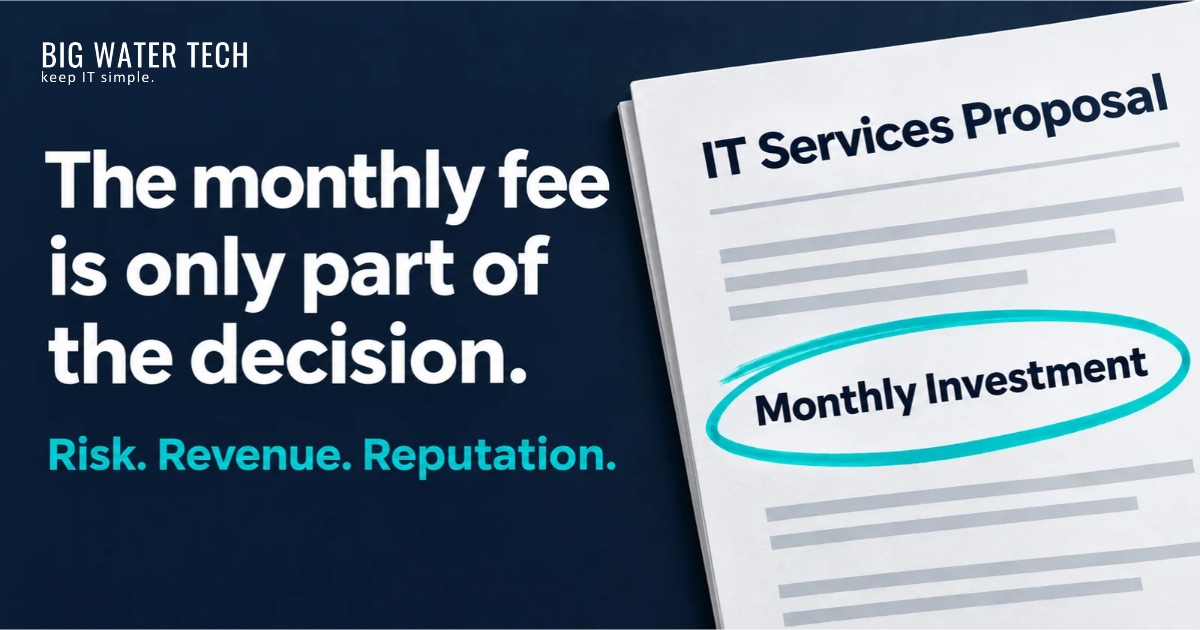
Small business technology decisions affect the risk an owner accepts, the revenue a team can produce and the reputation clients learn to trust. Evaluating IT spending through those three areas gives owners a better basis for decisions than comparing monthly fees alone.
I run a business too. I want to understand why we’re spending money and what we expect to get from it. A lower bill is worth considering. But I also want to know whether we’ve reduced an expense or moved it somewhere that’s harder to see.
An employee spending an hour working around a recurring problem still costs money. A client waiting for work that should have been finished yesterday has an opinion about that delay. Neither shows up on the IT invoice.
That’s why I keep coming back to the 3 Rs: Risk, Revenue and Reputation.
What does technology risk mean for a small business?
Technology risk is the chance that a failure, security incident or dependency will interfere with the business. For an owner, the useful discussion is about what happens to the work and how long the disruption is acceptable.
If your practice management system is unavailable tomorrow morning, what can your staff still do? How long before appointments or deadlines start being affected? Having a backup doesn’t settle those questions. You need to understand how the business will recover and what it will take to get people working again.
The same applies to relying on one person. If one employee handles an important system and nobody else knows how it works, their departure creates a business problem. Documentation and access arrangements deserve attention before that person leaves.
Every business accepts risk. A law firm facing a filing deadline has different priorities from a manufacturer whose production depends on access to its ERP system. The owner needs enough information to decide what level of disruption the business can tolerate.
I want that decision made while there’s time to consider the options. Learning during an outage that recovery takes much longer than you expected is an expensive way to discover what you bought.
How does technology affect revenue and staff capacity?
Technology affects revenue by changing how much work employees can complete and how quickly completed work gets billed. Recurring problems consume paid time and limit capacity, even when the team manages to meet its deadlines.
Think about an accounting firm that enters client information into one system, copies it into another and checks both records because the systems don’t share information. The work gets done. Everyone knows the steps. That doesn’t make the process inexpensive.
Here’s an illustration using assumed figures. If 10 employees each lose 15 minutes a workday to avoidable workarounds, that’s 12.5 hours in a five-day week. At an assumed employment cost of $40 an hour, the firm has $500 of staff time tied up each week, or $25,000 over 50 working weeks.
That is a capacity calculation. Recovering those hours doesn’t automatically reduce payroll or add $25,000 to profit. The business has to put the time to use. If the team can complete additional client work or get invoices out sooner, there is a business outcome to measure.
Just because the work is getting done doesn’t mean we’ve made it easy to do. Before buying another application, I want to understand where the time goes and whether the proposed change improves the whole job.
Why does IT reliability affect your business reputation?
IT reliability affects reputation because clients experience the delays and service failures that technology problems create. They judge whether they can depend on your business, regardless of which system caused the problem.
A law firm’s clients expect confidential information to stay protected. A medical practice’s patients expect to reach the office and have the information needed for their appointment available. Those expectations are part of the service they’re relying on.
An occasional problem is something most people understand. Repeated explanations that the system is down start to sound like a normal part of doing business with you.
You spend years earning trust. Clients refer people because they’re comfortable putting their own name behind yours. If they start wondering whether you’ll deliver when you said you would, that affects more than the current assignment.
Of the three Rs, reputation is the one I worry about most. You can repair a system and resume working. You don’t get to decide when a client feels confident in you again.
How should owners evaluate an IT proposal beyond price?
Evaluate an IT proposal by the business problem it addresses, the expected outcome and the responsibilities included in the service. Compare the cost with the disruption or wasted effort the business is already accepting.
Consider a second internet connection. Its value depends on how much of your operation stops when the primary connection fails. A firm using cloud applications and internet-based phones has a different dependency from a business that can keep working offline for several hours.
The proposal should explain how the backup connection takes over and who verifies that it works. The owner should be able to relate that expense to the work it protects.
The same reasoning applies to a software replacement. A demonstration that makes one step faster isn’t enough. What happens when the finished work moves to the next person? If employees still spend the same amount of time checking and transferring information, the overall improvement is smaller than the demonstration suggests.
Useful questions for the discussion include:
What business problem are we paying to address?
What happens if we leave it as it is?
How will we tell whether the change worked?
Who owns the ongoing work, including testing and follow-through?
This is where I expect a technology partner to explain the recommendation in terms the owner can judge. Equipment specifications have a place, but they don’t tell you whether the investment fits your business.
IT planning for Michigan small businesses
For owners in Southfield, Troy and across Metro Detroit, the right IT plan needs to reflect how the business earns its money. A professional firm working against client deadlines needs a different conversation from a manufacturer planning around production schedules.
At Big Water Technologies, we use those business needs to guide conversations about managed IT services and the systems your team relies on. Understanding where work gets held up helps establish what deserves attention and what the spending is supposed to accomplish.
If you’re reviewing your IT budget, bring us the recurring problem your team has learned to work around. We’ll help you evaluate its business impact and the options for addressing it.
Frequently asked questions about small business IT spending
What are the 3 Rs of business technology decisions?
In this approach, the 3 Rs are Risk, Revenue and Reputation. They help owners evaluate the disruption they’re willing to accept, the work technology enables and the client trust their service depends on.
How do you calculate the cost of IT downtime?
Start with the employees unable to work and the duration of the interruption. Add relevant recovery expenses and costs such as overtime or delayed production. Distinguish revenue that is permanently lost from work or billing that is delayed, and avoid counting the same loss twice.
Does saving staff time with technology increase profit?
Saving staff time creates available capacity. Profit improves when the business uses that capacity to complete profitable work or reduce an actual expense. Hours saved and dollars saved need separate measurements.
How much should a small business spend on IT?
A useful budget starts with the systems the business depends on and the outcomes it needs. Compare proposals with equivalent responsibilities and service coverage. A monthly price alone doesn’t show what recovery support or ongoing work is included.

Ready For A No-Nonsense Approach To IT?
Hire us to set your IT strategy up for sustainable success.
Learn about our proven No-Nonsense approach.
Get an IT roadmap designed specifically for you.
Fearlessly grow your business.
Get in Touch with us!
Call us at (248) 220-7714 or or fill out the form below.
Categories
Featured Posts
Small Business IT Decisions: Risk, Revenue and Reputation
Small business technology decisions affect the risk an owner accepts, the revenue a team can produce and the reputation clients learn to trust. Evaluating IT spending through those three areas gives owners a better basis for decisions than comparing monthly fees alone.
I run a business too. I want to understand why we’re spending money and what we expect to get from it. A lower bill is worth considering. But I also want to know whether we’ve reduced an expense or moved it somewhere that’s harder to see.
An employee spending an hour working around a recurring problem still costs money. A client waiting for work that should have been finished yesterday has an opinion about that delay. Neither shows up on the IT invoice.
That’s why I keep coming back to the 3 Rs: Risk, Revenue and Reputation.
What does technology risk mean for a small business?
Technology risk is the chance that a failure, security incident or dependency will interfere with the business. For an owner, the useful discussion is about what happens to the work and how long the disruption is acceptable.
If your practice management system is unavailable tomorrow morning, what can your staff still do? How long before appointments or deadlines start being affected? Having a backup doesn’t settle those questions. You need to understand how the business will recover and what it will take to get people working again.
The same applies to relying on one person. If one employee handles an important system and nobody else knows how it works, their departure creates a business problem. Documentation and access arrangements deserve attention before that person leaves.
Every business accepts risk. A law firm facing a filing deadline has different priorities from a manufacturer whose production depends on access to its ERP system. The owner needs enough information to decide what level of disruption the business can tolerate.
I want that decision made while there’s time to consider the options. Learning during an outage that recovery takes much longer than you expected is an expensive way to discover what you bought.
How does technology affect revenue and staff capacity?
Technology affects revenue by changing how much work employees can complete and how quickly completed work gets billed. Recurring problems consume paid time and limit capacity, even when the team manages to meet its deadlines.
Think about an accounting firm that enters client information into one system, copies it into another and checks both records because the systems don’t share information. The work gets done. Everyone knows the steps. That doesn’t make the process inexpensive.
Here’s an illustration using assumed figures. If 10 employees each lose 15 minutes a workday to avoidable workarounds, that’s 12.5 hours in a five-day week. At an assumed employment cost of $40 an hour, the firm has $500 of staff time tied up each week, or $25,000 over 50 working weeks.
That is a capacity calculation. Recovering those hours doesn’t automatically reduce payroll or add $25,000 to profit. The business has to put the time to use. If the team can complete additional client work or get invoices out sooner, there is a business outcome to measure.
Just because the work is getting done doesn’t mean we’ve made it easy to do. Before buying another application, I want to understand where the time goes and whether the proposed change improves the whole job.
Why does IT reliability affect your business reputation?
IT reliability affects reputation because clients experience the delays and service failures that technology problems create. They judge whether they can depend on your business, regardless of which system caused the problem.
A law firm’s clients expect confidential information to stay protected. A medical practice’s patients expect to reach the office and have the information needed for their appointment available. Those expectations are part of the service they’re relying on.
An occasional problem is something most people understand. Repeated explanations that the system is down start to sound like a normal part of doing business with you.
You spend years earning trust. Clients refer people because they’re comfortable putting their own name behind yours. If they start wondering whether you’ll deliver when you said you would, that affects more than the current assignment.
Of the three Rs, reputation is the one I worry about most. You can repair a system and resume working. You don’t get to decide when a client feels confident in you again.
How should owners evaluate an IT proposal beyond price?
Evaluate an IT proposal by the business problem it addresses, the expected outcome and the responsibilities included in the service. Compare the cost with the disruption or wasted effort the business is already accepting.
Consider a second internet connection. Its value depends on how much of your operation stops when the primary connection fails. A firm using cloud applications and internet-based phones has a different dependency from a business that can keep working offline for several hours.
The proposal should explain how the backup connection takes over and who verifies that it works. The owner should be able to relate that expense to the work it protects.
The same reasoning applies to a software replacement. A demonstration that makes one step faster isn’t enough. What happens when the finished work moves to the next person? If employees still spend the same amount of time checking and transferring information, the overall improvement is smaller than the demonstration suggests.
Useful questions for the discussion include:
What business problem are we paying to address?
What happens if we leave it as it is?
How will we tell whether the change worked?
Who owns the ongoing work, including testing and follow-through?
This is where I expect a technology partner to explain the recommendation in terms the owner can judge. Equipment specifications have a place, but they don’t tell you whether the investment fits your business.
IT planning for Michigan small businesses
For owners in Southfield, Troy and across Metro Detroit, the right IT plan needs to reflect how the business earns its money. A professional firm working against client deadlines needs a different conversation from a manufacturer planning around production schedules.
At Big Water Technologies, we use those business needs to guide conversations about managed IT services and the systems your team relies on. Understanding where work gets held up helps establish what deserves attention and what the spending is supposed to accomplish.
If you’re reviewing your IT budget, bring us the recurring problem your team has learned to work around. We’ll help you evaluate its business impact and the options for addressing it.
Frequently asked questions about small business IT spending
What are the 3 Rs of business technology decisions?
In this approach, the 3 Rs are Risk, Revenue and Reputation. They help owners evaluate the disruption they’re willing to accept, the work technology enables and the client trust their service depends on.
How do you calculate the cost of IT downtime?
Start with the employees unable to work and the duration of the interruption. Add relevant recovery expenses and costs such as overtime or delayed production. Distinguish revenue that is permanently lost from work or billing that is delayed, and avoid counting the same loss twice.
Does saving staff time with technology increase profit?
Saving staff time creates available capacity. Profit improves when the business uses that capacity to complete profitable work or reduce an actual expense. Hours saved and dollars saved need separate measurements.
How much should a small business spend on IT?
A useful budget starts with the systems the business depends on and the outcomes it needs. Compare proposals with equivalent responsibilities and service coverage. A monthly price alone doesn’t show what recovery support or ongoing work is included.
Enroll in Our Email Course

Learn How a No-Nonsense IT Strategy Benefits Your ComBullet listpany:
Strategies to allocate your IT budget efficiently
Enhance cybersecurity defenses on a bButtonudget
Ensure your technology investments continue to serve your business as it grows

Looking to Switch?
© Copyright 2026 Big Water Tech. All Rights Reserved. Built in partnership with Tech Pro Marketing | Privacy Policy | Client Portal | Areas We Serve


